
Iran Remote Workforce Report 2025: Hiring, Onboarding Trends, Communication, and Business Insight

- Iran Remote Workforce Report 2025: Hiring, Onboarding Trends, Communication, and Business Insight
- Iran as a Growing Remote Talent Market
- Hiring Iranian Talent: Expectations and Common Missteps
- Cross-Cultural Communication Challenges
- Managing Iranian Teams: Time, Tone, and Holidays
- Onboarding Iranian Employees: The First Week Matters
- AI Tools That Bridge Cultural Gaps
- Conclusion
- Leave A Comment Cancel reply
As global companies increasingly collaborate with Iranian professionals across fields such as software development, design, digital marketing, and operations, many discover that success depends on far more than language skills or technical ability. Tone, work rhythm, cultural expectations, holidays, and onboarding approaches significantly impact productivity and retention.
Survey data and real case insights show that most challenges faced by foreign teams working with Iranian employees are not caused by performance issues—but by mismatched communication styles, unclear processes, and differences in expectations during hiring, onboarding, and ongoing collaboration.
This report consolidates practical findings and visual data to help international companies better understand how to recruit, communicate with, manage, and onboard Iranian remote talent—while also introducing AI-driven tools that solve these issues in real time.
Iran as a Growing Remote Talent Market
Iran has become a valuable hub for remote hiring, especially for roles in:
-
Software engineering & frontend/backend development
-
UI/UX and product design
-
Content creation & digital marketing
-
Operations and customer support
-
Localization, research, and strategy roles
Key Market Advantages:
-
Competitive salary expectations compared to Europe or the Gulf region
-
Strong English comprehension in major urban and tech sectors
-
Large numbers of educated graduates entering the workforce
-
Remote-first experience due to economic and geopolitical factors
-
Willingness to work with international startups and SMEs
Average Hiring Timelines:
-
Local-to-local recruiting: 7–14 days
-
Foreign employer recruiting remotely: 14–30 days
However, companies consistently run into predictable obstacles—mostly rooted in cultural nuance and workflow expectations.
Hiring Iranian Talent: Expectations and Common Missteps
Writing a job description that “sounds normal” to Western audiences often results in low engagement in Iran. The top barriers include:
-
Tone perceived as too direct or too casual
-
Job titles that don’t match the Iranian labor market
-
Salary phrasing misunderstandings (e.g., “$X per year”)
-
Not mentioning contract type, insurance, or work schedule
-
Over-translated or auto-generated Persian text
Foreign companies frequently report that their postings receive few or no qualified applicants—not because of lack of talent, but because the message didn’t feel relevant or culturally aware.
Cross-Cultural Communication Challenges
Once hired, communication becomes the next friction point. Based on aggregated feedback, the most common issues include:
-
Delayed responses without explanation
-
Hesitation to say “no” directly
-
Misinterpretation of short, direct messages
-
Unclear timeline reminders
-
Silence around blockers or delays

Top Challenges in Cross-Cultural Team Management
This visual illustrates the most common pain points:
-
Tone Misalignment – 35%
-
Delayed Updates – 25%
-
Holiday Impact – 20%
-
Unclear Onboarding – 20%
Western-style blunt reminders like “Any updates?”, “This is late,” or “I need this ASAP” can unintentionally feel aggressive or disrespectful. Conversely, Iranian professionals may delay responses to avoid conflict or craft a culturally suitable reply.
Managing Iranian Teams: Time, Tone, and Holidays
Foreign managers often face surprises not because of poor performance, but due to different pacing and calendar structures:
Workweek Rhythm
-
Working Days: Saturday to Wednesday
-
Weekend: Thursday & Friday (not Saturday–Sunday)
Messaging someone on a Friday is like emailing someone in the U.S. on Sunday—responses should not be expected.
Holiday Reality
Nowruz (Persian New Year) is the single most impactful time period. Although officially under two weeks, many teams enter low-activity mode before and after. Other religious and national holidays also affect deliverables and availability.
Reporting Style
Unlike Western employees who often provide voluntary status updates, Iranian professionals usually wait until asked. Without structured follow-ups, managers may misread silence as inaction or disengagement.
Onboarding Iranian Employees: The First Week Matters
The first week determines employee confidence, clarity, and engagement. Many foreign companies unintentionally create confusion by:
-
Sending overly short welcome messages
-
Assigning tasks without context
-
Assuming new hires will ask questions directly
-
Ignoring tone or courtesy in instructions
-
Failing to define communication channels clearly
Iranian employees value respect, clarity, and structure early on.
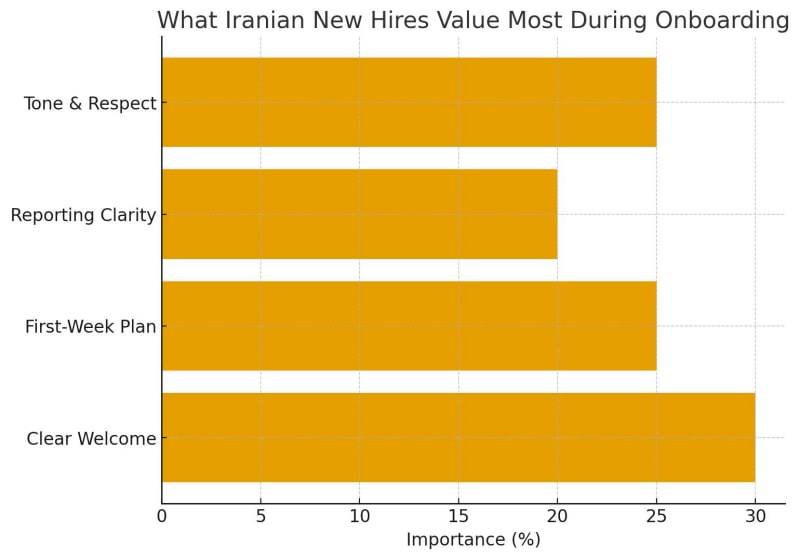
What Iranian New Hires Value Most During Onboarding
Key expectations based on insight data:
-
Clear Welcome – 30%
-
First-Week Plan – 25%
-
Tone & Respect – 25%
-
Reporting Clarity – 20%
Western-style independence can feel like abandonment; detailed onboarding boosts productivity, not dependency.
AI Tools That Bridge Cultural Gaps
To solve the recurring patterns identified in this report, four specialized tools were developed and tested with real hiring and management cases:
✅ 1. Recruitment Helper
Creates job descriptions aligned with Iranian tone, terminology, salary phrasing, and expectations—without risky translation.
✅ 2. Team Communication Assistant
Generates polite reminders, feedback messages, and update requests that maintain urgency without sounding harsh.
✅ 3. Business Insight Writer
Produces professional progress summaries, delay explanations, and culturally aware status updates—ideal for remote collaboration.
✅ 4. Onboarding Guide Generator
Forms structured, culturally appropriate welcome messages and first-week plans that reduce hesitation and confusion.
These tools eliminate the need for local consultants, translators, or multiple draft revisions—saving time while improving cooperation.
Conclusion
Working with Iranian professionals offers high value, strong skills, and long-term loyalty—when communication and management adapt to cultural realities. The top challenges in hiring, onboarding, coordination, and reporting are both predictable and solvable.
Instead of relying on trial and error, global teams are now using AI tools to:
-
Avoid tone misalignment
-
Prevent silent delays
-
Clarify expectations faster
-
Respect local holidays and rhythms
-
Strengthen onboarding impact
-
Maintain professionalism without friction
By approaching Iran as a culturally distinct and talent-rich workforce—not an extension of Western workflows—teams can dramatically improve performance and collaboration outcomes in 2025 and beyond.