
Why Is Investing a More Powerful Tool to Build Long-Term Wealth Than Saving?
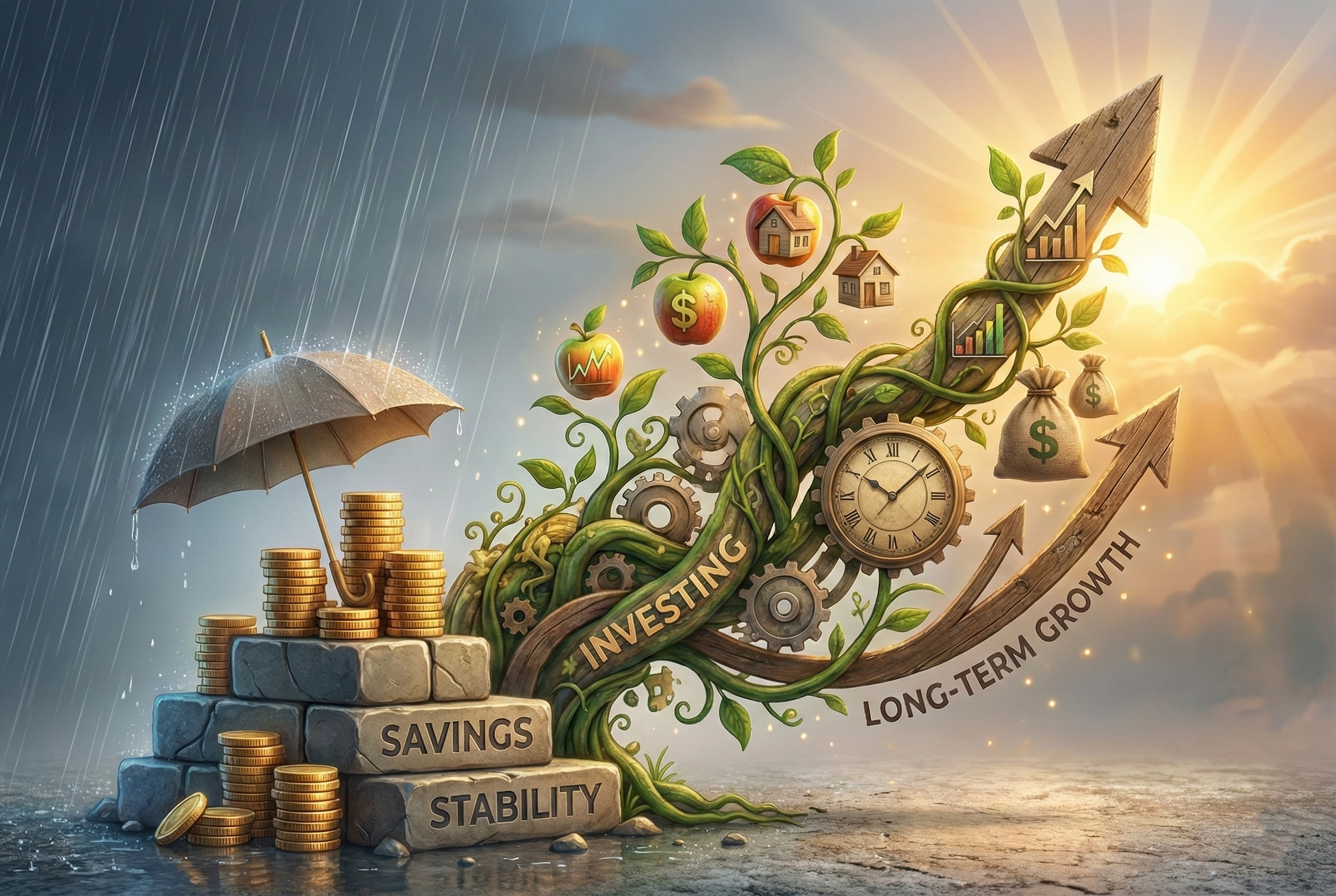
- Why Is Investing a More Powerful Tool to Build Long-Term Wealth Than Saving?
- Saving vs. investing (how I explain it without the jargon)
- Why I believe investing is usually more powerful for long-term wealth?
- Saving still matters. I treat it like my foundation.
- So… do I save first or invest first?
- The business lens: saving is runway, investing is growth capital
- A few myths I had to unlearn
- 2-minute quiz: should I focus on saving or investing right now?
- FAQs
- Bottom line
Quick Answer: I think investing is usually the stronger tool for long-term wealth because it can compound faster, has a better shot at staying ahead of inflation, and lets people own productive assets. I still save on purpose—saving is what keeps my life stable when something unexpected happens.
Not sure where you fall? Take my 2-minute quiz (see the table of contents).
Saving vs. investing (how I explain it without the jargon)
When I say saving, I mean parking money somewhere stable and easy to reach—money I might need soon.
When I say investing, I mean putting money into assets that can grow over time—knowing the value will bounce around, but betting on the long game.
Quick comparison chart
| Category | Saving | Investing |
|---|---|---|
| Best for | Emergencies + short-term goals | Long-term goals + wealth building |
| Typical timeline | Months to ~3 years | 5+ years (often 10–30) |
| Risk | Low (but not zero) | Higher (prices fluctuate) |
| Liquidity | High | Medium (depends on account/asset) |
| How I “earn” | Interest | Growth + income (dividends/interest) |
| The big tradeoff | Stability | Higher long-term growth potential |
Why I believe investing is usually more powerful for long-term wealth?
1) Compounding is the real superpower
Compounding is the closest thing I’ve seen to “money doing work while I sleep.”
When returns compound, I’m not just earning on the money I put in—I’m earning on the growth that money already created. That’s why starting earlier (even with small amounts) often beats starting later with bigger amounts.
If I had to put it in a simple image:
Saving feels like walking up a hill. Investing feels like stepping onto a moving walkway that speeds up the longer I stay on it.
2) Inflation is the quiet reason saving alone can fall behind
I used to think, “If my account balance goes up, I’m winning.” Then I realized the more important question is: What will this money buy later?
Prices tend to rise over time. So if my money grows slowly (or barely grows), my purchasing power can shrink. Over decades, that matters a lot. Investing isn’t guaranteed—but it usually gives me a better chance to keep up with (or beat) rising costs.
3) Investing lets me own assets that can grow
When I invest, I’m buying into things that can grow or generate income—like companies, bonds, or funds. Those assets are designed to produce something: profits, dividends, interest, or long-term value growth.
Cash is useful. I keep cash.
But cash typically isn’t a growth machine.
4) Opportunity cost is the price of waiting
The most expensive habit I see is waiting for the perfect moment:
“I’ll invest once I feel totally ready.”
I get it—investing can feel intimidating. But if my goal is long-term wealth, time is the ingredient I can’t replace. Waiting doesn’t always feel costly because I’m not losing money in a visible way. But I might be losing years of compounding.
Saving still matters. I treat it like my foundation.
Saving is what keeps my finances from turning into a crisis when real life happens.
Here’s what saving does really well for me:
- Emergency buffer (car repair, medical bill, sudden job change)
- Short-term goals (travel, moving costs, a near-term purchase)
- Peace of mind (so I don’t panic when markets get ugly)
If I’m being honest, saving also protects my investing behavior. When I have a real cash cushion, I’m less likely to make emotional decisions with my investments.
So… do I save first or invest first?
I don’t treat it like an either/or. I treat it like a sequence.
Step 1: I build a basic emergency fund
My personal rule: I want a buffer for essentials—housing, food, utilities, insurance.
If I’m starting from zero, I set a smaller first target (like $500–$1,000) just to break the “one surprise = debt” pattern.
Step 2: I tackle high-interest debt
If I’m carrying high-interest credit card debt, paying it down is often the cleanest win. It’s like earning a strong “guaranteed return” by stopping the interest bleeding.
Step 3: If I have an employer match, I take it
If my job is offering a retirement match, I prioritize getting it. It’s one of the few times in personal finance where the math is almost unfair—in a good way.
Step 4: I invest for long-term goals
If I don’t need the money for years, investing usually makes more sense to me. I expect ups and downs, but I care more about where I’m likely to be in 10–20 years than where my account is next month.
Step 5: I automate and scale
This is where things get real. I don’t try to “motivate” myself forever—I automate contributions. Then I increase them gradually when I get a raise, pay off a bill, or stabilize my expenses.
The business lens: saving is runway, investing is growth capital
When I think like a business owner, the difference becomes obvious:
- Saving is runway. It keeps the lights on. It reduces risk.
- Investing is growth capital. It’s how money turns into more money over time.
A good business doesn’t sit on every dollar forever. It keeps enough cash to survive shocks, then deploys capital into things that grow the company. That’s the same mindset I use personally: protect stability first, then build growth.
My takeaway:
I’m not choosing saving or investing. I’m choosing stability + growth, in that order.
A few myths I had to unlearn
Myth 1: “I should wait until I have a lot saved before I invest.”
What I learned: Waiting can cost compounding time. Even a small automatic investment can build momentum.
Myth 2: “Investing is basically gambling.”
What I learned: Chasing hype can be gambling. Long-term, diversified investing is more like a plan—still risky, but manageable with time and discipline.
Myth 3: “A high-yield savings account is enough.”
What I learned: It’s great for short-term cash and peace of mind. But for long-term wealth, I usually need more growth potential than cash can reliably provide.
2-minute quiz: should I focus on saving or investing right now?
I score each question 0 / 1 / 2 and add them up.
- Do I have an emergency fund?
0 = none • 1 = under 3 months • 2 = 3+ months - Do I carry high-interest debt (like credit cards)?
0 = yes, significant • 1 = some • 2 = no / paid monthly - How stable is my income over the next 6–12 months?
0 = uncertain • 1 = somewhat stable • 2 = very stable - Will I need this money within 3 years?
0 = yes • 1 = maybe • 2 = no - How do I react to market drops?
0 = panic / can’t sleep • 1 = uneasy but okay • 2 = I can stay the course - Do I have access to an employer match?
0 = no • 1 = not sure • 2 = yes - Can I automate monthly contributions?
0 = not right now • 1 = maybe • 2 = yes - What’s my main goal for this money?
0 = emergency / near-term purchase • 1 = mixed • 2 = long-term wealth/retirement
My result
- 0–6: Safety-First Saver
I focus on building my safety net and reducing high-interest debt. If possible, I still start investing small—just enough to build the habit. - 7–11: Balanced Builder
I do both: keep my emergency fund solid and invest consistently. My priority is automation and slowly increasing my contribution rate. - 12–16: Growth-First Investor
My foundation looks solid. I keep a sensible cash buffer, then lean into long-term investing and consistency.
FAQs
What are two disadvantages of keeping my money only in savings accounts, compared to investing?
- My money may grow too slowly for long-term wealth goals.
- Inflation can shrink my purchasing power over time.
Why is investing better than saving for long-term goals?
Because investing usually offers higher long-term growth potential, which matters a lot over long time horizons.
How much should I save before I start investing?
I like having a basic emergency cushion first. If I’m starting from zero, I build a small buffer, then invest consistently while continuing to strengthen my emergency fund.
Isn’t investing risky?
Yes—prices move. But saving has risks too (inflation and missed growth). I match the tool to the timeline: I save for short-term needs and invest for long-term goals.
Bottom line
Saving keeps me steady. Investing helps me grow.
When I want long-term wealth, I build enough savings to feel safe—then I invest consistently so time and compounding can do their thing.